


Losing a pet can be one of the first times a child experiences the death of someone they love. For a child, a pet is not simply an animal in the household. They may have grown up with their dog or cat, talked to them, played with them every day, and relied on them for comfort.
Because of this, the loss can feel confusing and overwhelming.
Children also don’t always express grief in the same way adults do. Some may cry openly, while others become quiet, angry, restless, or seem to return to normal very quickly. Some children may ask the same questions repeatedly because they are still trying to understand what happened.
There is no single “right” way for a child to grieve.
What matters most is helping them understand what happened, giving them permission to feel whatever they feel, and making sure they don’t have to go through the experience alone.
Why Losing a Pet Can Be Especially Hard for Children
For many children, a pet is part of their everyday life.
Their pet may be waiting by the door when they come home from school, sleeping beside their bed, sitting with them while they do homework, or joining them outside to play. These ordinary moments can make the relationship feel like a natural part of childhood.
When the pet is suddenly gone, children may notice the absence in very practical ways.
The empty bed.
The unused food bowl.
The leash hanging by the door.
The quiet place where their pet used to sleep.
These small reminders can make the loss feel real again and again.
A child’s understanding of death also depends on their age and development. Younger children may not fully understand that death is permanent, while older children may understand the concept but still struggle with the emotions surrounding it.
The most helpful approach is usually simple, honest, patient, and age-appropriate.

Children Grieve Differently at Different Ages
There is no exact timeline for how a child should respond to pet loss. Their reaction can depend on their age, personality, relationship with the pet, previous experiences with death, and the way adults around them respond.
Toddlers and Very Young Children
Very young children may have difficulty understanding what death means.
They may ask when the pet is coming home or expect to see them at their usual place. They may understand that something has changed without understanding that the change is permanent.
At this age, simple language is usually best.
You might say:
“Our dog died. His body stopped working, and he isn’t coming back.”
Avoid giving a young child too much information at once. Let their questions guide the conversation.
They may ask the same question several times. This does not necessarily mean they weren’t listening. They may simply need repeated explanations as they gradually understand what death means.
Preschool and Early School-Age Children
Children in this age group may understand more about death but can still have misconceptions.
They may wonder whether they somehow caused the pet’s death or whether the pet might come back later.
Reassurance can be important.
You can explain what happened using simple, concrete language and make it clear that the death was not their fault.
Children at this age may also move quickly between sadness and play. One moment they may be crying about their pet, and a short time later they may be playing normally.
This does not mean they didn’t love their pet.
Children often process difficult emotions in shorter periods and return to activities that make them feel safe.
Older Children and Tweens
Older children may understand death in a way that is closer to an adult’s understanding, but that doesn’t necessarily make the experience easier.
They may think deeply about the pet’s final days, wonder what happens after death, or worry about losing another person or animal they love.
They may also prefer more privacy when grieving.
Give them space without withdrawing your support. Let them know that they can talk to you whenever they want, even if they don’t want to talk right away.
Talk About Death Honestly and in Simple Language
One of the most important things parents can do is use clear language when explaining what happened.
Phrases such as “went to sleep,” “went away,” or “we lost our pet” may sound gentle, but they can sometimes create confusion for children.
A young child may literally interpret “went to sleep” and become afraid of sleeping themselves.
Instead, use the word “died” and explain what it means in language they can understand.
For example:
“Our cat died because her body became very sick and stopped working.”
Or:
“Our dog was very old, and his body could no longer keep working.”
The exact explanation will depend on what happened, but the goal is to be honest without overwhelming the child with unnecessary details.
You don’t need to have every answer.
It’s also perfectly acceptable to say:
“I don’t know the answer to that, but we can talk about it together.”

Let Your Child Ask Questions
Children often have questions that may seem unexpected to adults.
“Where is my dog now?”
“Can we get another one?”
“Will I die too?”
“Did I make him sick?”
“Can the vet bring her back?”
“Why doesn’t she wake up?”
These questions can be difficult, especially when you’re grieving too.
Try not to dismiss them or rush to change the subject.
Instead, answer as honestly and simply as you can.
If the question is connected to fear, offer reassurance as well as information.
For example, if a child asks whether another family member will die, you might say:
“Everyone dies someday, but most people live for a very long time. Right now, you are safe, and I’m here with you.”
Children don’t always ask questions only once. They may return to the same questions days or weeks later.
That’s normal.
Their understanding can change as they grow, and grief can bring the same questions back to the surface.
Let Children See That Grief Is Normal
Children often learn how to respond to grief partly by watching the adults around them.
If you’re sad, you don’t have to hide every tear.
You can say:
“I’m feeling sad because I miss our dog too.”
This shows your child that sadness is not something they need to be embarrassed about or hide.
At the same time, you don’t need to make your child responsible for comforting you.
It’s okay to show emotion while also reassuring them that you’re able to take care of yourself and that they are safe.
There is no need to create a perfect emotional environment.
Sometimes simply being honest is enough:
“I feel sad today. I miss her.”
That can give a child permission to say the same thing.
Help Your Child Express Their Feelings
Not every child wants to sit down and talk about grief.
Some children may find it easier to express themselves through activities rather than conversation.
Depending on their age, you might encourage them to:
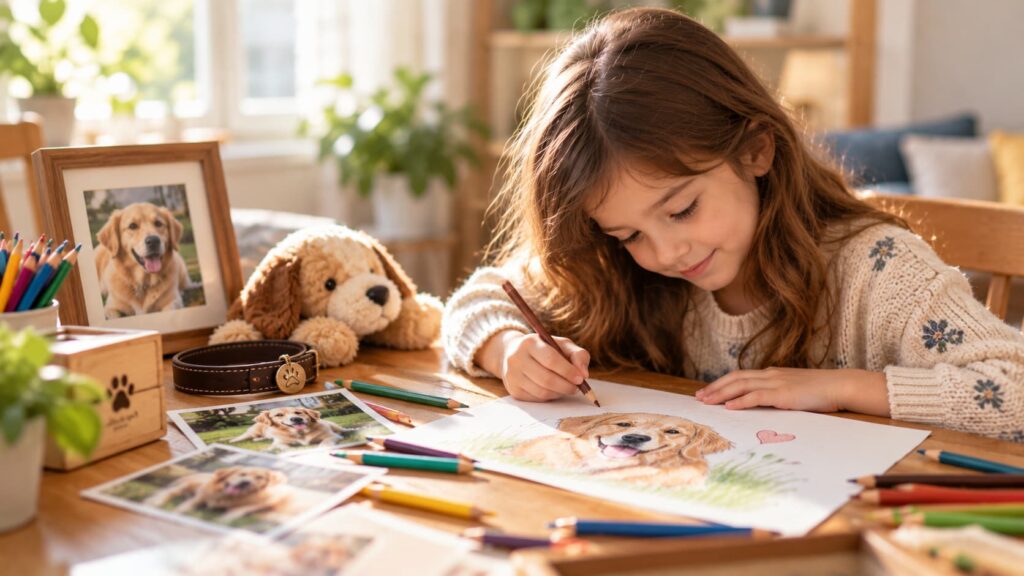
- Draw a picture of their pet
- Write a letter to their pet
- Make a small photo album
- Tell stories about funny memories
- Create a memory box
- Choose a favorite photograph
- Write down their favorite things about the pet
- Make a small piece of artwork
- Look through old photos together
- Plant a flower or tree in memory of their pet
There is no need to turn this into a formal project.
Sometimes a child simply wants to draw a picture and leave it on the shelf.
That’s enough.
The purpose isn’t to make grief disappear. It is to give the child a safe way to express something that may be difficult to explain with words.
Keep Some Normal Routines
After a pet dies, the whole family may feel emotionally unsettled.
For a child, familiar routines can provide a sense of security.
Try to maintain ordinary parts of their day when possible.
School, meals, bedtime, playtime, sports, and time with friends can all help provide structure while the child adjusts to the change.
This doesn’t mean pretending that nothing happened.
You can acknowledge the loss while continuing with everyday life.
For example:
“I know you’re missing Max today. We still need to get ready for school, and we’ll talk more when you come home.”
Routine and grief can exist together.
Don’t Rush to Replace the Pet
After losing a pet, a child may immediately ask for another animal.
Sometimes this is because they genuinely want another companion. Sometimes they simply want the painful emptiness in the house to go away.
There is no universal rule about when or whether to get another pet.
Try not to make the decision solely as a way to stop your child’s sadness.
A new pet cannot replace the relationship your child had with the previous one.
If your family eventually decides to welcome another animal, it can be helpful to explain that the new pet is not replacing the one who died.
You can love a new pet while still remembering the old one.
Create a Small Way to Remember Your Pet Together
Children often benefit from having something tangible that connects them to their memories.
A simple remembrance activity can help make the relationship feel acknowledged rather than erased.
You might create a small memory corner with a favorite photo, collar, toy, or drawing.
You could also make a memory box together and let your child choose what belongs inside.
For some families, creating a personalized keepsake can become another way to preserve those memories.
The important part isn’t how elaborate the memorial is.
It is the opportunity to say:
“This pet was important to our family, and we can remember them.”
If you’re looking for more ideas, you can explore our guide to 50+ Pet Memorial Ideas to Honor Your Beloved Companion.

What If My Child Doesn’t Want to Talk?
Don’t force the conversation.
Some children may not want to talk immediately. Others may express their feelings indirectly through drawing, writing, playing, or simply spending more time with their parents.
Let them know the door is open.
You might say:
“You don’t have to talk about it right now. But if you want to talk about Buddy later, I’m here.”
This gives the child control without making them feel alone.
You can also check in naturally rather than repeatedly asking, “Are you okay?”
A simple comment such as:
“I was thinking about Luna today. I remember how she used to sit by the window.”
may give your child an opportunity to join the conversation if they want to.
Sometimes children need time before they know what they want to say.
When Should Parents Seek Extra Help?
Most children gradually adjust to the loss of a pet with support from family and trusted adults.
However, parents should pay attention if a child’s distress becomes severe, persistent, or begins to interfere significantly with everyday life.
For example, it may be worth seeking additional professional support if a child experiences ongoing problems with sleep, school, eating, relationships, or daily activities, or if their sadness, anxiety, fear, or preoccupation with death remains intense for a prolonged period.
Any talk of wanting to die, self-harm, or joining the deceased pet should always be taken seriously and addressed promptly with appropriate professional help.
You don’t need to wait until you are certain that something is wrong.
If you’re worried about your child, talking with a pediatrician, child psychologist, counselor, or another qualified professional can help you understand what support may be appropriate.
A Simple Way to Help Your Child Through Pet Loss
There isn’t a perfect formula for helping a child through the death of a pet.
But a few simple things can make a meaningful difference:
Be honest about what happened.
Use simple, age-appropriate language.
Let your child ask questions.
Don’t tell them how they should feel.
Let them see that sadness is a normal response to losing someone they love.
Give them different ways to express their feelings.
Keep familiar routines when possible.
Give them time.
And remember the pet together.
You don’t have to make every conversation about grief. Sometimes the most helpful thing you can do is simply continue being there.
A child may remember the loss for a long time, but they can also learn something important from the experience: that it is okay to love deeply, to miss someone, and to carry meaningful memories forward.
Final Thoughts
For a child, losing a pet can be a very big experience.
It may be their first encounter with death, their first experience of losing a daily companion, or simply the first time they have felt a familiar part of their world suddenly disappear.
They may cry.
They may ask difficult questions.
They may become quiet.
They may seem completely fine one afternoon and become sad again the next morning.
All of these responses can be part of grief.
What children often need most is not a perfect explanation or a way to make the sadness disappear.
They need someone who is willing to stay beside them while they learn what loss feels like.
Talk about their pet.
Answer their questions.
Look at the photographs.
Remember the funny moments.
Keep the routines that make them feel safe.
And when they are ready, help them find a small way to keep those memories close.
The relationship they had with their pet mattered. Helping a child understand that can be one of the most meaningful parts of helping them through the loss.
If you’re looking for more guidance on supporting someone after a pet dies, you may also find our guide How to Help Someone Grieving the Loss of a Pet helpful.
Frequently Asked Questions
How do I explain the death of a pet to a young child?
Use simple and honest language. Tell the child that the pet died and explain what that means in an age-appropriate way. Avoid confusing phrases such as “went to sleep” or “went away.” Give your child plenty of opportunities to ask questions.
Should I let my child see me cry after our pet dies?
Yes. You don’t need to hide every emotion from your child. Seeing a parent feel sad can help children understand that grief is a normal response to losing someone we love. You can also reassure them that you are okay and that they are safe.
Is it normal for a child to play soon after losing a pet?
Yes. Children may move between sadness and normal activities quickly. Playing does not mean they didn’t love their pet or that they have stopped grieving. Children often process difficult emotions differently from adults.
Should I get another pet to help my child feel better?
There is no single right answer. A new pet should not be treated as a replacement for the pet who died. Give your family time to consider whether everyone is genuinely ready for another animal.
What can I do if my child refuses to talk about the pet?
Don’t force them. Let them know that you’re available whenever they want to talk. Some children express grief through drawing, writing, playing, or other activities rather than direct conversation. You can also gently share your own memories of the pet without demanding a response.
Can creating a memorial help a child cope with pet loss?
It can. A simple memorial activity can give children a tangible way to remember their pet and acknowledge the importance of the relationship. This might be a drawing, photograph, memory box, small display, or another personal keepsake.
When should I seek professional help for my child’s grief?
Consider seeking professional guidance if your child’s grief remains severe or begins to significantly interfere with everyday activities such as school, sleep, eating, relationships, or normal routines. If a child talks about wanting to die or harm themselves, seek professional help immediately.
How long does it take for a child to recover from losing a pet?
There is no fixed timeline. Children may continue to miss their pet long after the strongest feelings of grief have eased. The goal is not to make them forget the pet but to help them gradually adjust to life without them while keeping the positive memories.